Custom mesh baskets for annealing and tempering processes
A mesh basket used inside an annealing or tempering furnace must do more than hold a batch of components. It must tolerate repeated heating and cooling, allow heat and gases to circulate, support the load without distortion, and remain safe during loading and unloading. The right basket becomes an extension of the furnace operation rather than a vulnerable accessory that slows the production line.
Successful selection depends on the actual workpiece, temperature range, furnace atmosphere, cycle duration, and handling method. These variables determine the alloy, mesh aperture, reinforcement, welding method, and expected service life. For Australian heat-treatment operations, clear specifications and dependable replacement supply are equally important.
Designing a basket around the furnace
The design process should begin with the furnace rather than the basket catalogue. A rectangular basket for a bell or pit furnace may need different lifting arrangements from one used in a box furnace, while vacuum, salt-bath, and atmospheric furnaces each present distinct restrictions. Basket dimensions must provide clearance for thermal expansion, furnace elements, thermocouples, and the movement of workpieces during treatment.
Basket geometry also depends on how material enters and leaves the furnace. Horizontal loading suits dense components and crane-assisted handling, whereas a deeper hanging basket may suit narrow shafts or smaller batch furnaces. Openings should be large enough to prevent trapped gas pockets, particularly where oil, moisture, or cleaning residue remains on the workpiece. Adequate ventilation supports more uniform heating and reduces local temperature differences.
The specified load should reflect both weight and load distribution. Reinforced bases, rims, corners, and lifting points may be needed for heavy or unevenly distributed parts. A practical drawing should identify the basket’s orientation, usable internal space, attachment method, maximum working load, and any required handling clearances. These details give the fabricator a dependable basis for quotation and production.
Selecting metals for repeated thermal cycling
Stainless steel is widely used because it combines corrosion resistance, strength, and fabrication flexibility, but no grade is suitable for every heat-treatment environment. Grade 304 and 316 stainless steels can perform well in many moderate-temperature atmospheres, provided the load and cycle time remain within their design limits. At higher annealing temperatures, strength loss and oxidation may make a heat-resistant grade such as 309 or 310 more appropriate.
Ferritic grades such as 430 offer useful oxidation resistance in certain air atmospheres, while other stainless steels or alloys may be required for demanding radiant, carburising, or vacuum applications. Material certificates should be available where traceability matters. The alloy should be checked against the actual furnace temperature, atmosphere, required cleanliness, and expected number of cycles rather than selected from a generic temperature table alone.
Aluminium, copper, and coated steels may suit lower-temperature or specialised processes, but each introduces limits. Aluminium has relatively low high-temperature strength. Copper can contaminate steel surfaces, and zinc-based coatings can volatilise or flake inside a furnace. Where a coating protects the basket, it should be stable under the specified cycle and compatible with the atmosphere. Material selection should also consider whether spare baskets can be recoated without changing their fit.
Mesh, welds, and load management
A useful specification for a new or replacement basket separates operating conditions from construction details:
- Maximum service temperature and furnace atmosphere
- Workpiece dimensions, weight, and loading pattern
- Heating and cooling rates, cycle duration, and daily use
- Required basket life and cleaning method
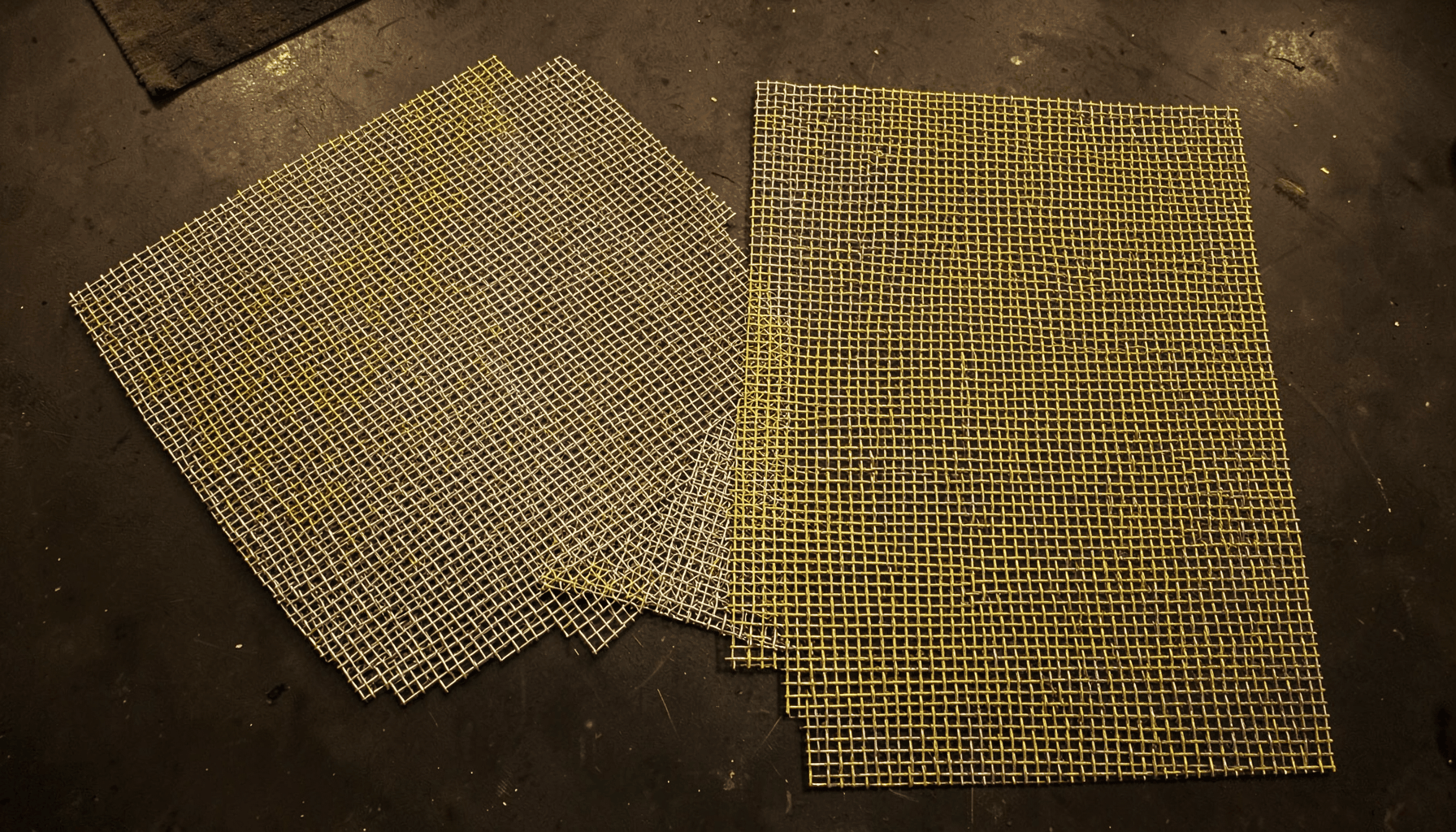
The mesh itself balances open area against part retention. Fine woven mesh prevents small components from falling, but a very small aperture can restrict circulation and retain debris. Welded mesh offers larger openings and straightforward panel dimensions, while woven wire provides adaptable apertures and smooth wire surfaces. Expanded or perforated sheet may also work where the workpiece is relatively large and impact loads are low.
Construction details should be reviewed before fabrication begins:
- Wire diameter and aperture matched to the smallest workpiece
- Reinforced base, rim, corners, and lifting interfaces
- Continuous welds with smooth, accessible internal joints
- Identification plate showing capacity, alloy, order number, and date
Weld quality is critical because fatigue cracks often begin at geometrically stressed corners. Weld sequencing should control distortion, and reinforcement should transfer the load into the basket without creating sharp internal points that could damage delicate parts. Bases may need solid plate, ribbed supports, or a combination of mesh and structural sections. The same discipline in distributing forces through connections is valuable when comparing wire mesh support systems, where each panel must participate in a defined load path.
Inspection should cover aperture consistency, weld penetration, dimensional accuracy, and the fit of lifting hardware. A sample fit check in the customer’s furnace can reveal issues that cannot be detected from a general drawing. It can also confirm that operators can load and unload the basket safely without contacting sensitive components or the furnace lining.
Meeting Australian operating and sourcing requirements
Australian manufacturers, foundries, and engineering workshops in Melbourne, Sydney, Brisbane, and Perth commonly rely on specialist heat-treatment providers for annealing, stress relief, hardening, and tempering. Those operations support automotive components, fabricated steel, mining equipment, rail components, agricultural machinery, and other industrial products. Each sector has different batch sizes, component weights, and turnaround requirements, so baskets must be matched to local production patterns rather than treated as universal warehouse accessories.
Workplace safety is a central consideration. Safe Work Australia guidance, together with relevant state-based work health and safety requirements, affects how baskets are moved, inspected, and used near furnaces. A basket should not become an improvised lifting device. Crane and hoist procedures, lifting accessories, guarding, and operator training remain the responsibility of the workplace, while the basket needs clearly rated lifting points, documented capacity, and predictable handling balance.
Importing custom baskets from China also requires sound commercial planning. Australian buyers should confirm the correct tariff classification, import duty, GST treatment, delivery terms, and customs documentation through their broker. Freight is only part of the total cost; replacement lead time, shipping damage, and the availability of holding spares can affect furnace uptime. Purchasers should compare these practical factors with locally sourced or fabricated alternatives and establish a specification that a supplier can reproduce consistently.
Moving from enquiry to production
A productive request to Shuo Ke Wire Mesh Product Technology Co., Ltd. should include drawings or photographs, workpiece dimensions, load weight, operating temperatures, furnace type, atmosphere, cycle frequency, and the preferred loading method. If the basket must fit an existing furnace or trolley, accurate measurements of the opening, internal cavity, hinges, rails, or lifting points are essential. Information about expected annual usage helps determine whether a standard, enhanced, or sacrificial basket design is more appropriate.
The supplier can then compare woven, welded, and perforated options and select suitable framing for the load. Custom identification, handles, dividers, feet, and reinforcement can be incorporated without compromising the mesh pattern. Prototype approval or a dimensional sample is advisable before a full production run, especially for new furnace tooling or unusual components.
Send Shuo Ke your component details, operating cycle, and dimensional requirements. The company can develop a production-ready mesh basket built around your furnace, workload, and Australian handling requirements.