
Custom Mesh Baskets for Hot-Dip Galvanizing of Small Metal Parts
Small metal components can be difficult to galvanize consistently. Loose parts may fall through lifting equipment, nest together, trap chemicals, or retain liquid zinc in pockets. A properly engineered mesh basket provides a controlled way to carry, immerse, drain, and unload these components throughout the hot-dip galvanizing process.
Custom basket design is especially valuable when the parts vary in size, have threaded sections, include drilled holes, or require a specific loading quantity. Basket dimensions, mesh opening, wire diameter, reinforcement, lifting points, and surface finish all influence the efficiency and quality of galvanizing operations.
Shuo Ke Wire Mesh Product Technology Co., Ltd. produces customized metal mesh products for industrial and engineering applications. By combining wire mesh processing with practical fabrication, the company can develop baskets suited to small fasteners, brackets, stamped parts, castings, hardware, and other components that need reliable handling during zinc coating.
Why Basket Design Matters In Galvanizing
Hot-dip galvanizing involves several stages, including degreasing, pickling, rinsing, fluxing, immersion in molten zinc, withdrawal, cooling, and inspection. A basket must remain stable and functional through chemical treatment and exposure to molten zinc. Weak welds, unsuitable materials, or poor drainage can reduce service life and create handling problems.
The basket also affects the way parts contact the zinc bath. If small components are packed too tightly, surfaces may remain shielded from the molten zinc. Trapped air, pretreatment liquids, and excess zinc can cause bare areas, rough deposits, drips, or unwanted buildup. Open mesh and an appropriate loading depth help promote circulation and drainage.
A custom galvanized parts basket should support the process without damaging the workpieces. Smooth edges reduce scratching, while correctly positioned lifting eyes allow the basket to be moved safely by cranes, hoists, or automated handling systems. Reinforced corners and a rigid frame help prevent distortion when the basket is full.
Selecting Materials And Construction
The choice of basket material depends on temperature, chemical exposure, load weight, handling frequency, and the galvanizing plant’s operating method. Carbon steel is often selected for robust industrial baskets, especially when the basket is intended for repeated use and can tolerate gradual zinc pickup. Stainless steel may be specified where corrosion resistance, cleanliness, or dimensional stability is important.
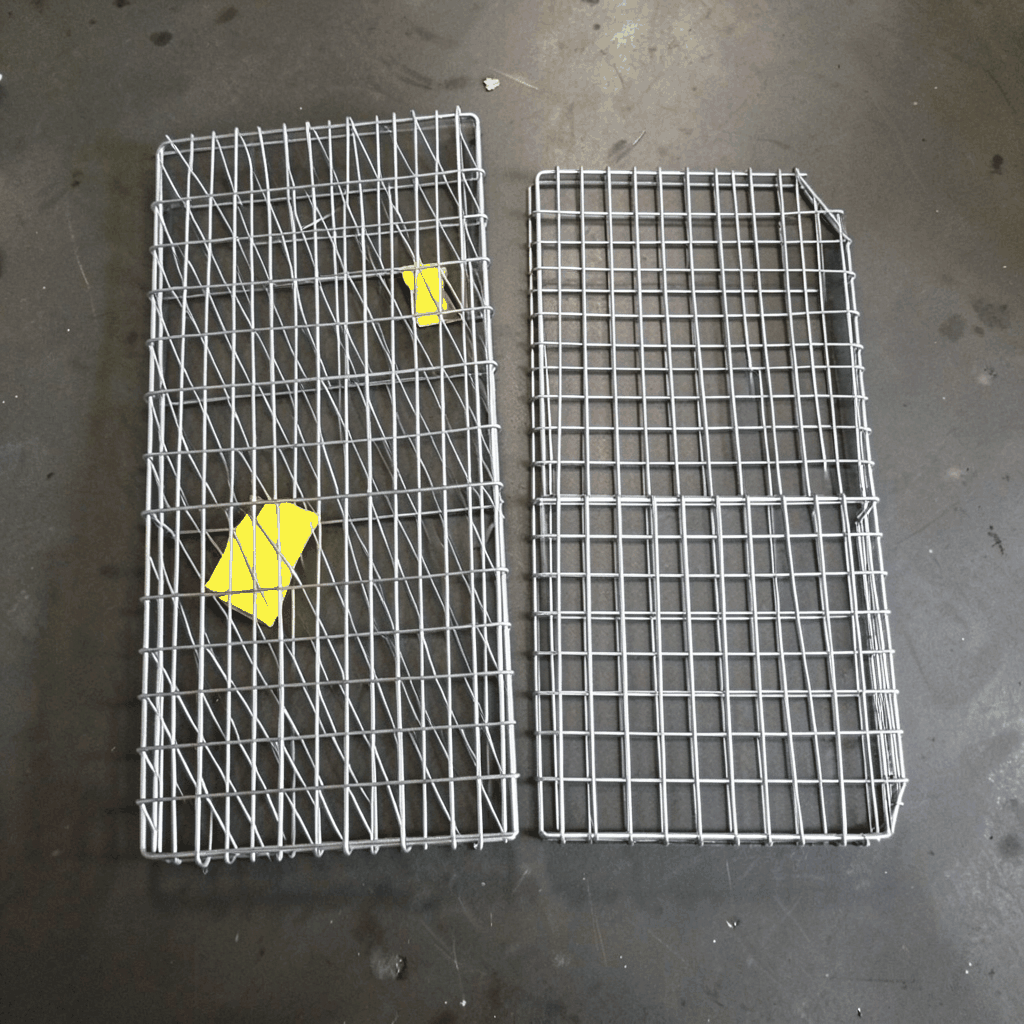
Metal mesh can be combined with welded frames, angle sections, flat bars, rods, hinges, lifting lugs, and removable covers. Expanded metal or perforated sheet may be suitable when smaller openings or higher containment are required. Woven wire mesh can provide a larger open area and flexible configuration for lightweight components.
Construction details should be selected according to the parts being processed. A fine mesh may retain small washers or pins, while a coarse mesh can improve zinc flow around larger brackets. Reinforcement under the base is useful for heavy loads, and side rails can prevent parts from spilling during lifting. Welded joints should be placed where they can be inspected and should not create sharp projections.
Mesh Openings, Drainage, And Part Retention
Mesh opening size is one of the most important design variables. Openings must be small enough to retain the smallest component while remaining large enough to support cleaning, chemical circulation, and molten zinc drainage. The correct balance depends on the geometry of the parts rather than their nominal weight alone.
For parts with cavities, blind holes, channels, or overlapping surfaces, basket orientation may be as important as mesh selection. Internal liquid must be able to escape during withdrawal. In some cases, sloped sides, raised bases, perforated drain panels, or divided compartments can reduce pooling and prevent components from settling into dense layers.
A basket should also account for the possibility of parts interlocking. Small hooks, threaded pieces, and stamped components can form clusters when shaken or lifted. Internal dividers, shallow loading zones, or removable trays can keep parts distributed. For delicate components, a finer support surface can prevent deformation while preserving access to the zinc bath.
The basket’s overall dimensions should suit the galvanizing kettle and the available handling equipment. Oversized baskets may be difficult to immerse evenly, while excessively deep baskets can encourage nesting. A practical design uses the available bath volume efficiently without making loading, draining, and unloading difficult.
Comparing Basket Configurations
Different mesh basket styles serve different production requirements. A simple open basket may be suitable for sturdy parts with uncomplicated shapes, while a framed or compartmented version can provide better control for small, mixed, or easily tangled components. The best choice depends on the part dimensions, batch weight, process temperature, and handling routine.
The following comparison outlines common configurations used for hot-dip galvanizing and related thermal or chemical processing applications:
| Basket Configuration | Suitable Parts | Main Advantages | Design Considerations |
|---|---|---|---|
| Open welded wire basket | Brackets, clips, washers, robust hardware | Good circulation, easy loading, economical construction | Mesh must retain the smallest parts |
| Reinforced heavy-duty basket | Castings, dense steel fittings, high-volume batches | High load capacity and improved rigidity | Requires stronger base and lifting points |
| Fine-mesh basket | Pins, small fasteners, compact precision parts | Reduces loss of small components | Fine openings may slow drainage and cleaning |
| Compartmented basket | Mixed parts, tangled components, delicate pieces | Separates loads and limits nesting | Adds fabrication time and reduces usable volume |
| Basket with removable tray | Repeated batch production and controlled unloading | Simplifies transfer and part separation | Tray fit and lifting access require close tolerances |
| Perforated sheet basket | Tiny parts or materials needing full containment | High retention and durable surfaces | Less open area than wire mesh and heavier construction |
A manufacturer can combine these features into a purpose-built design. For example, a basket may use a welded wire body, a reinforced flat-bar rim, a perforated base, and removable internal partitions. This approach provides retention where needed while preserving open areas for process fluids and molten zinc.
Lifting, Loading, And Workplace Safety
The lifting system must be designed around the loaded basket weight rather than the empty basket weight. Load-bearing lugs, lifting bars, shackles, and suspension points should distribute force evenly and keep the basket level during movement. Uneven lifting can spill parts, stress welds, and expose operators to hot surfaces or splashing material.
Basket handles and lifting eyes should have sufficient clearance for the plant’s hooks and hoists. Their position must also allow the basket to enter and leave the kettle without striking the rim. Where baskets are turned or tilted for drainage, the frame needs controlled pivot points or a compatible lifting arrangement.
Loading access affects productivity. A wide top opening is convenient for bulk parts, while a hinged lid may be appropriate for lightweight components that could shift during transport. Removable trays can support repeatable batch quantities and reduce manual sorting. Rounded corners and deburred mesh edges improve operator safety during loading and unloading.
The basket should also be inspected at regular intervals. Zinc accumulation can add weight and reduce opening size, while repeated thermal cycles may loosen welds or distort the frame. A maintenance plan can include checking lifting points, measuring critical dimensions, removing excessive zinc buildup, and replacing worn mesh panels.
Customization For Different Metal Parts
Custom fabrication begins with information about the parts and the process. Useful specifications include the smallest and largest component dimensions, individual and batch weights, part material, shape, surface condition, required quantity per load, kettle dimensions, and available lifting equipment. Photos, drawings, or sample components can help clarify how parts behave when loaded.
Designers may propose a basket with a single chamber, multiple compartments, a reinforced base, or a removable insert. Stainless steel, carbon steel, aluminum, or other suitable alloys can be considered according to operating conditions. The final selection should account for heat exposure, chemical contact, stiffness, weldability, and expected service life.
Surface treatment and fabrication quality are equally important. Welds should be continuous where structural strength requires it, with spatter removed from contact areas. Edges should be smooth, and the basket should be dimensionally checked before shipment. If the basket must fit a production line, tolerances for width, height, lifting clearance, and tray insertion should be documented.
For export orders or repeat production, a clear drawing and inspection standard help maintain consistency. A first sample can be tested with representative parts before the full quantity is manufactured. Feedback from loading, immersion, withdrawal, and unloading can then be used to refine the mesh opening, frame, or lifting system.
Practical Specifications To Confirm
Before requesting a quotation for an industrial galvanizing basket, confirm the operating details that affect construction. A technically suitable basket can improve throughput, reduce lost parts, and limit repeated manual handling. It can also help the galvanizer maintain a more predictable coating process by presenting components consistently.
The following specifications are particularly useful:
- Smallest part size, largest part size, and the risk of parts interlocking
- Empty basket weight, maximum working load, and expected lifting method
- Required mesh opening, wire diameter, frame profile, and base reinforcement
- Kettle dimensions, immersion depth, basket clearance, and withdrawal direction
- Need for dividers, removable trays, hinged covers, sloped panels, or drain openings
- Material preference, operating temperature, chemical exposure, and maintenance frequency
A supplier should also know whether the basket will be used exclusively for hot-dip galvanizing or for other processes such as cleaning, plating, heat treatment, or parts washing. Multi-purpose use may require a different alloy, a more open design, or additional reinforcement.
When specifications are incomplete, a manufacturer can review samples and recommend a practical configuration. The objective is to create a basket that contains the parts securely, supports fluid movement, handles the working load, and integrates with the existing plant equipment.
Reliable Fabrication For Industrial Mesh Baskets
Custom mesh baskets are functional process equipment rather than simple containers. Their performance depends on the relationship between mesh, frame, drainage, lifting hardware, load distribution, and the geometry of the parts being treated. Careful design can reduce product loss, improve coating access, and make the galvanizing workflow safer and more repeatable.
Shuo Ke Wire Mesh Product Technology Co., Ltd. supports customized metal mesh fabrication for industrial users that need specific dimensions, materials, openings, and structural details. Its manufacturing experience across wire mesh products and fabricated metal components provides a foundation for developing baskets for small parts, hardware, fittings, and other production loads.
Share your part drawings, sample dimensions, batch weight, kettle limitations, and handling requirements with the engineering team to develop a custom basket configuration. A purpose-built solution can then be reviewed for mesh retention, drainage, lifting safety, durability, and efficient hot-dip galvanizing performance.