
Custom wire mesh dividers for recycling sorting facilities
Recycling plants depend on clear material separation, reliable flow control, and equipment that can withstand constant industrial use. When plastics, ferrous metals, aluminum, packaging waste, and residue move through the same facility, a well-designed divider can improve organization around conveyors, sorting stations, storage bays, and processing equipment.
Custom wire mesh dividers provide a practical way to separate work zones without blocking visibility or airflow. Unlike solid barriers, mesh partitions allow operators to monitor material movement, identify contamination, and maintain safer sightlines across the recycling floor. Their open construction also supports ventilation around balers, shredders, granulators, and wash-line equipment.
Shuo Ke Wire Mesh Product Technology Co., Ltd. manufactures and processes metal mesh products for industrial, architectural, and municipal applications. By selecting the right alloy, opening size, wire diameter, frame design, and mounting method, a recycling operation can receive a divider system suited to its material stream and site conditions.
Why recycling facilities need tailored mesh separation
Plastic and metal recovery lines rarely share the same layout or operating requirements. A facility handling PET bottles may need clearly marked compartments for transparent, colored, and contaminated plastics. A plant processing mixed scrap may require separated areas for steel, aluminum, copper, and non-recyclable residue. Standard barriers may fit one location while creating access, visibility, or maintenance problems in another.
Custom mesh dividers help define these zones with less disruption to daily operations. They can be installed between sorting stations, around temporary storage areas, alongside conveyor transfer points, or around machinery that requires controlled access. Panels may be fixed to floors, posts, frames, ceilings, or existing structural members, depending on the facility layout.
The open mesh structure is especially valuable where supervisors need continuous visual control. Workers can see accumulated material levels, forklift movement, emergency routes, and equipment status without walking around every partition. This improves operational awareness while maintaining a physical boundary between different waste streams.
Design choices that affect sorting efficiency
A divider should be designed around the material, equipment, and people it will serve. Mesh opening size is one of the most important factors. Smaller openings can help prevent loose fragments from passing through a barrier, while larger openings provide greater visibility and lower material weight. The suitable configuration depends on particle size, impact risk, cleaning requirements, and the desired level of containment.
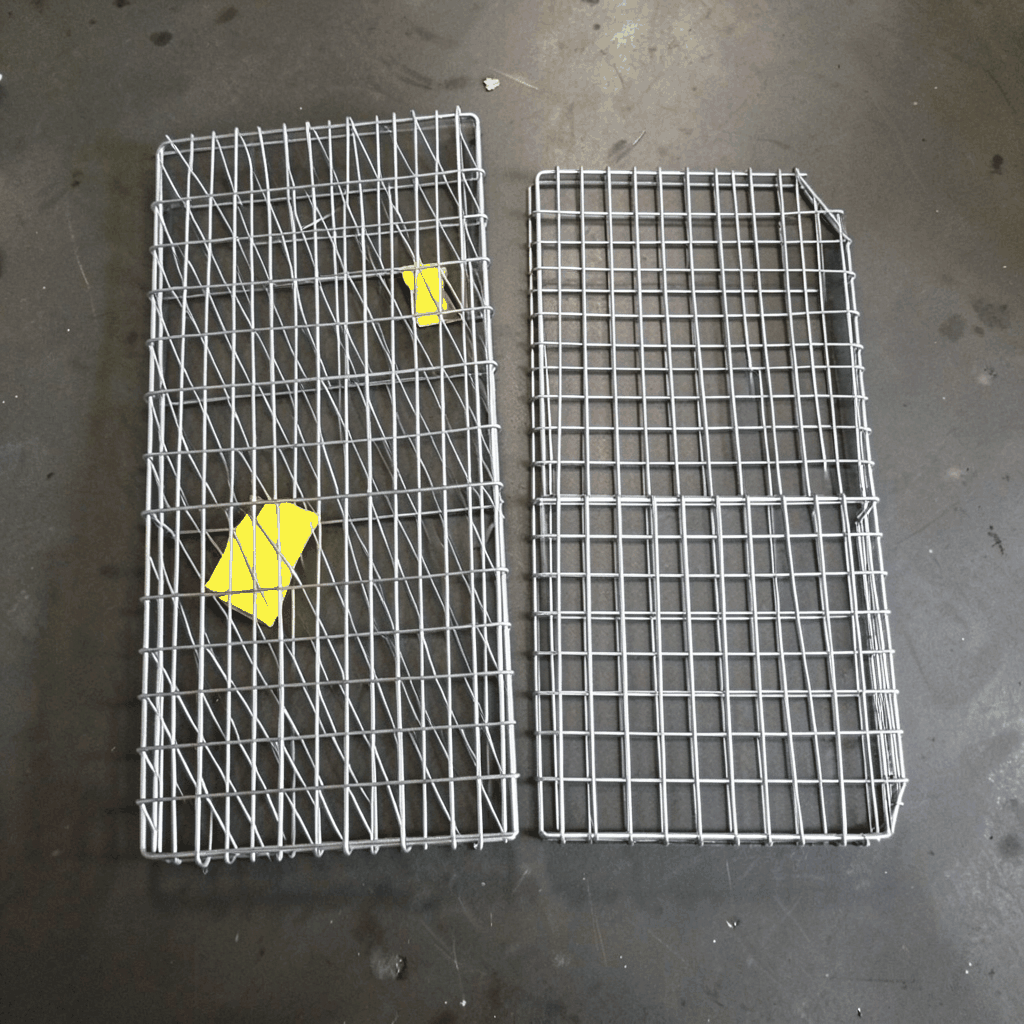
Wire diameter and panel construction also influence performance. Heavier wire and reinforced frames are appropriate near forklift traffic, scrap handling areas, and loading points. Lighter decorative or architectural mesh may be sufficient for low-impact internal partitions. Welded mesh panels generally provide a rigid, stable surface, while woven mesh can offer flexibility and a distinct appearance for selected applications.
Access should be considered during the design stage rather than added later. Swing gates, sliding gates, removable panels, inspection openings, and service doors can be integrated into a custom divider system. This allows operators to clean around conveyors, replace screens, remove full containers, and reach emergency equipment without dismantling the entire partition.
Choosing metal mesh for plastics and metals
Material selection should reflect the chemical, mechanical, and environmental conditions of the recycling process. Stainless steel mesh is often suitable for wash-down areas, humid facilities, plastic flake processing, and locations exposed to cleaning chemicals. Grades such as 304 or 316 can be considered according to corrosion exposure, sanitation expectations, and budget.
Aluminum mesh provides low weight and good corrosion resistance, making it useful where panels must be moved, suspended, or installed on structures with limited load capacity. It can also support a clean, finished appearance in public-facing recycling centers. However, areas exposed to heavy impact or abrasive scrap may require a more robust steel or stainless steel construction.
Carbon steel and galvanized steel are practical options for general sorting areas, storage bays, and industrial partitions where strength and cost efficiency are priorities. Surface treatments such as galvanizing, powder coating, or other protective finishes can improve resistance to moisture and wear. Copper and specialty alloys may be selected for particular technical, decorative, or conductivity-related requirements, although they are less common for standard separation barriers.
| Application area | Suitable mesh approach | Main design priority | Common material options |
|---|---|---|---|
| Plastic bottle sorting | Rigid welded mesh with clear visibility | Preventing material crossover | Stainless steel, galvanized steel |
| Plastic flake or wash-line zone | Corrosion-resistant fine mesh | Hygiene, cleaning, moisture resistance | 304 or 316 stainless steel |
| Ferrous scrap storage | Heavy-duty welded panels | Impact resistance and stability | Carbon steel, galvanized steel |
| Aluminum separation area | Medium-weight mesh partitions | Low weight and easy access | Aluminum, stainless steel |
| Public recycling center | Finished architectural mesh | Appearance, visibility, safety | Aluminum, stainless steel, powder-coated steel |
| Conveyor service enclosure | Framed mesh with access gates | Maintenance access and guarding | Stainless steel, steel, aluminum |
Managing contamination and material flow
Efficient sorting depends on keeping recovered materials in defined paths. A divider cannot replace optical sorters, magnets, eddy-current separators, or manual inspection, but it can support each stage by controlling the surrounding workspace. For example, mesh panels can separate accepted material from rejected loads and create dedicated holding areas for plastics awaiting baling or metals awaiting shipment.
The height and position of a partition should match the movement of the material. A low divider may be suitable for marking storage lanes, while a taller enclosure may be needed around a conveyor discharge point. In areas where lightweight plastic packaging could be blown or thrown beyond its intended zone, additional height, a tighter mesh opening, or a partial solid skirt may improve containment.
Color coding and labeling can make the system easier to use. Powder-coated frames, identification plates, printed signs, and clearly marked gates help workers recognize destinations for PET, HDPE, films, steel cans, aluminum, and residue. Since mesh remains visible, labels can be mounted at eye level without preventing operators from seeing the contents of each bay.
Safety, cleaning, and long-term maintenance
Recycling environments contain sharp edges, irregular scrap, dust, moisture, and moving equipment. A properly manufactured divider should have stable posts, secure connections, smooth finished edges, and a structure capable of handling expected contact. Where employees work close to the panels, the mesh aperture should be selected to reduce the risk of finger, hand, or clothing entrapment.
The partition should also preserve required access to fire extinguishers, electrical cabinets, emergency stops, walkways, and evacuation routes. Gates need adequate clearance and dependable hardware. In high-traffic areas, protective bollards or offset posts can shield the mesh from forklifts and pallet trucks. These details are part of practical engineering, not simply visual finishing.
Cleaning requirements vary across recycling operations. Open mesh is generally easier to inspect than opaque walls, but dust and plastic fragments may still collect around frames and lower edges. Removable sections, raised panels, accessible fasteners, and corrosion-resistant surfaces can simplify routine cleaning. For wash-down zones, drainage, weld quality, and stainless steel selection deserve particular attention.
Integrating custom dividers into a working facility
A useful project begins with a review of the site rather than a selection from a standard panel catalog. Measurements should include floor conditions, ceiling height, conveyor position, forklift routes, drainage, electrical services, and existing structural supports. The material stream should also be evaluated: particle size, weight, moisture, temperature, impact frequency, and contamination level all affect the specification.
Shuo Ke can process metal mesh products in different patterns, dimensions, materials, and finishes for industrial applications. A custom request may include welded wire panels, woven mesh, framed screens, gates, guardrails, protective enclosures, or a combination of these products. This flexibility allows a divider system to serve both functional and visual requirements across a recycling plant.
Customization can also support future changes. Recycling facilities often add new collection streams, modify conveyor lines, or increase throughput. Modular panels and bolted connections may allow sections to be relocated or expanded. Fixed welded assemblies may be better where maximum rigidity and long-term stability are required. The appropriate choice depends on whether the facility values reconfiguration, impact resistance, installation speed, or a balance of these factors.
Practical specifications for a dependable system
When preparing a request for custom wire mesh dividers, provide as much operating information as possible. The following details help manufacturers recommend a suitable configuration:
- Material categories to be separated, including plastics, ferrous metals, aluminum, copper, and residue
- Required panel height, total length, mesh opening, wire diameter, and frame dimensions
- Exposure to moisture, wash-down procedures, chemicals, dust, heat, or outdoor weather
- Forklift routes, conveyor locations, access gates, inspection points, and emergency clearances
- Preferred alloy, surface finish, connection method, color, labeling, and future expansion needs
Drawings, photographs, site measurements, and expected loading conditions can further improve accuracy. If the divider will be installed near machinery, include the equipment manufacturer’s clearance requirements and any applicable guarding standards. If it will be used in a public or architectural setting, provide appearance expectations alongside the operational specifications.
The final solution should balance containment with visibility. A completely closed enclosure may restrict supervision and airflow, while an overly open design may allow lightweight waste to escape. Mesh type, panel height, lower skirts, gate placement, and frame reinforcement can be adjusted to create the right combination for each process area.
Custom wire mesh dividers give recycling facilities a durable method for organizing plastic and metal recovery zones while keeping operations visible and accessible. With the right materials and construction, they can support cleaner sorting, safer movement, easier maintenance, and a more adaptable plant layout.
Contact Shuo Ke Wire Mesh Product Technology Co., Ltd. with your material categories, site dimensions, mesh preferences, and operating conditions to develop a divider, partition, enclosure, or gate system engineered for your recycling process.