The engineering behind crimped mesh for solid-liquid separation
Crimped wire mesh is a practical separation medium for applications that require controlled openings, mechanical strength, and dependable liquid flow. Its performance comes from the interaction between wire diameter, aperture size, weave geometry, material properties, and operating conditions. A correctly engineered mesh can retain solids while allowing liquid to pass with predictable resistance.
Unlike a simple flat screen, crimped mesh uses pre-shaped wires that lock together and create a stable grid. The crimps add rigidity, support accurate openings, and help the screen maintain its shape under vibration, pressure, and repeated cleaning. These characteristics make crimped screens useful in mineral processing, food production, wastewater treatment, chemical handling, aggregate classification, and industrial filtration.
The best result depends on matching the mesh to the separation task rather than choosing an opening size alone. Particle shape, slurry concentration, temperature, corrosion exposure, flow direction, and cleaning method all affect service life and separation quality. Understanding the engineering behind the mesh helps plant designers select a screen that performs consistently instead of relying on trial and error.
How crimped mesh creates a stable separation surface
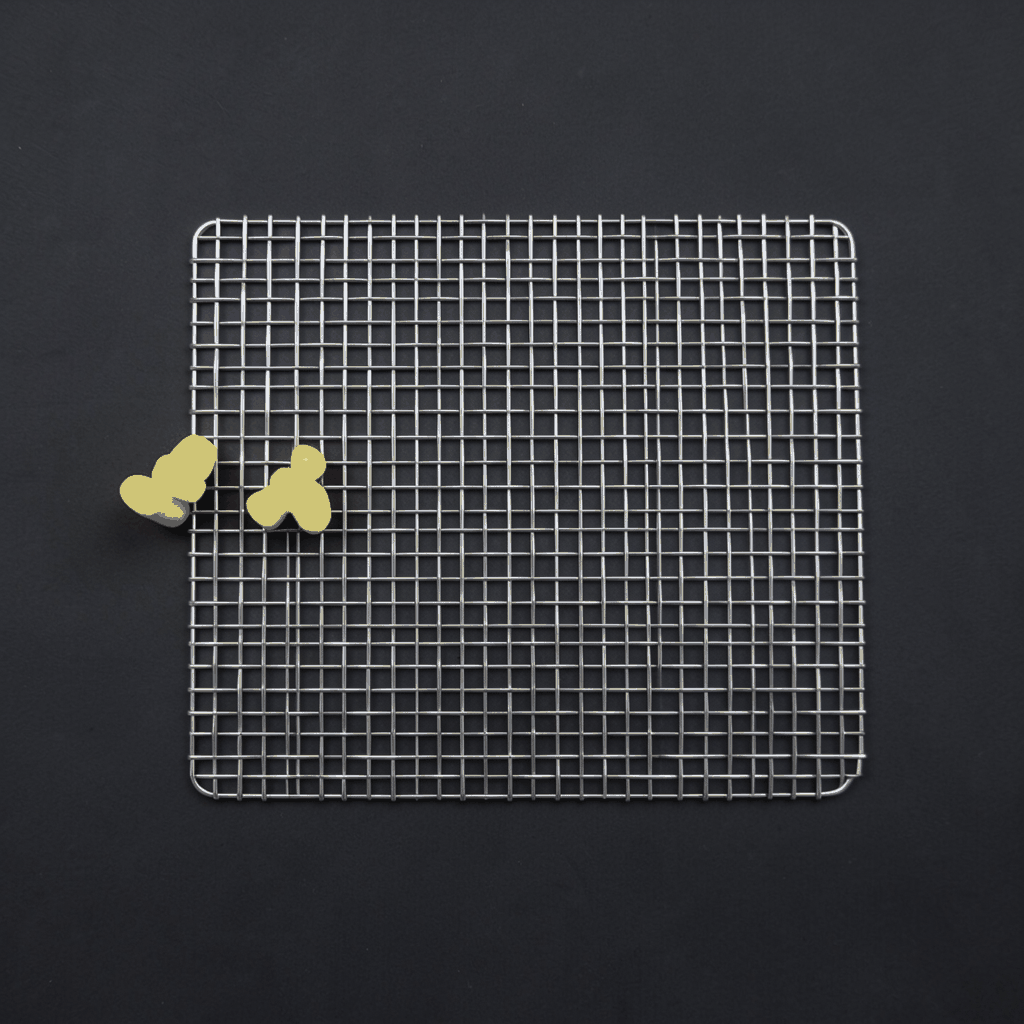
Crimping forms regular bends in the wire before the wires are woven or assembled. Depending on the design, the wires may intersect in a plain weave, twill weave, or another structural pattern. The bends help hold the wires in position and reduce movement when the mesh is exposed to load. This is especially important when the screen is stretched over a frame or installed in a vibrating separator.
The working aperture is the clear opening between neighboring wires. It determines which particles can pass through, but the effective cut size is also influenced by particle orientation and shape. A flat, round particle may pass through an opening that retains a longer or irregular particle with a similar nominal dimension. For this reason, mesh selection should consider the actual solids being separated rather than relying solely on a laboratory particle-size value.
Crimp geometry also affects the open-area percentage. A larger opening and thinner wire generally provide greater liquid throughput, while a smaller opening or heavier wire improves retention and wear resistance. Engineering the balance between these factors is central to preventing premature blinding, excessive pressure loss, or unwanted solids carryover.
The role of wire diameter, aperture, and open area
Wire diameter provides the mesh with load-bearing capacity. Heavy wire is better suited to abrasive slurries, coarse solids, and applications where the screen spans a large unsupported area. Fine wire can achieve precise filtration and high open area, but it has less resistance to impact, abrasion, and deformation. The correct choice depends on the force applied to individual wires as well as the total flow load.
Aperture size is usually specified by the clear distance between wires, while mesh count describes the number of openings within a defined length. These terms are related but not interchangeable because two meshes with the same mesh count can have different openings when their wire diameters differ. Clear opening, wire diameter, and pitch should be stated clearly on technical drawings and purchase specifications.
Open area strongly influences liquid capacity. A high open-area screen can reduce flow resistance and support greater throughput, but it may provide less structural strength and lower resistance to wear. A lower open-area screen can offer improved support for particles and a more robust working surface. In practice, the design should provide enough open area for the required flow while retaining a safety margin for fouling and gradual wear.
Weave patterns and their separation behavior
Plain weave is widely used because each warp wire passes over and under each weft wire in a regular sequence. It provides uniform openings and a relatively simple structure for general screening and filtration. Plain crimped mesh is often selected for moderate loads, classification, protective screening, and liquid-solid separation where consistent aperture geometry is important.
Twill weave places the wires in a staggered pattern that can support heavier wire or finer openings than a comparable plain weave. The structure may offer greater strength and improved resistance to deformation. It is useful when a screen must handle higher mechanical stress while maintaining a relatively fine separation range.
Dutch-type weaves use a different arrangement of wires, often combining a coarser support direction with a finer filtering direction. They can provide strong particle retention and a compact filtration surface, although their flow behavior and cleaning requirements differ from those of open square mesh. The selection should account for whether the priority is accurate sizing, high flow, fine retention, or resistance to pressure.
Materials selected for process conditions
Stainless steel is a common choice for solid-liquid separation because it combines strength, corrosion resistance, and dimensional stability. Grades such as 304 and 316 are frequently considered for general industrial service, with 316 often preferred where chlorides, salts, or more aggressive chemical exposure are present. The final grade should be selected according to the complete process chemistry, temperature, and cleaning agents.
Carbon steel and galvanized steel can be economical options for dry screening, construction-related separation, and less corrosive environments. They may be suitable where moisture exposure is limited or where a protective coating can provide adequate service. In wet processing, however, corrosion can reduce wire diameter, enlarge openings, and contaminate the handled material.
Copper, brass, and specialized alloys may be used where conductivity, non-sparking characteristics, or particular chemical compatibility is required. Aluminum offers low weight and useful corrosion resistance in selected environments, but its lower hardness may limit performance under severe abrasion. Material selection should evaluate tensile strength, hardness, corrosion behavior, temperature resistance, and compatibility with the separated product.
| Mesh characteristic | Main engineering effect | Typical benefit | Primary limitation |
|---|---|---|---|
| Larger aperture | Allows more liquid and larger particles to pass | Higher throughput and lower pressure loss | Reduced fine-particle retention |
| Smaller aperture | Restricts particle passage | Finer separation and improved solids capture | Greater blinding and cleaning demand |
| Heavier wire | Raises strength and wear resistance | Better support for abrasive or coarse solids | Lower open area |
| Higher open area | Increases available flow passage | Improved capacity and lower resistance | May reduce strength and retention |
| Plain weave | Creates regular square openings | Predictable general-purpose screening | Less suitable for some high-load conditions |
| Twill weave | Supports heavier or finer wire arrangements | Greater structural stability | More complex flow and cleaning behavior |
| Stainless steel construction | Resists corrosion and temperature effects | Long service life in wet processing | Higher initial material cost |
Flow, pressure, and particle movement
Solid-liquid separation is governed by the movement of liquid through openings and the movement of particles across or toward the screen surface. When slurry reaches the mesh, liquid can pass through the apertures while particles larger than the effective opening remain on the feed side. The result depends on residence time, screen inclination, vibration, feed distribution, and the formation of a solids layer.
Pressure difference drives liquid through the mesh, but excessive pressure can force deformable particles into openings. This may cause blinding, compacted filter cake, or difficult cleaning. A carefully selected aperture and controlled feed rate help maintain a stable operating condition. In gravity-fed systems, sufficient screen area and an appropriate slope are essential because available pressure is limited.
Particle concentration also changes performance. A dilute slurry may pass efficiently through a relatively open screen, while a dense slurry can quickly build a surface cake that reduces flow. The cake may improve fine-particle capture for a period, but it can eventually increase pressure loss. Operators should therefore evaluate both initial filtration performance and behavior after the screen has accumulated solids.
Designing for abrasion, vibration, and cleaning
Abrasive materials such as sand, mineral fragments, glass particles, and metal chips can wear wire crowns at the points where solids strike or slide across the surface. Wear gradually increases the aperture and can change the product cut. For abrasive service, a stronger wire, suitable alloy, reduced unsupported span, and controlled feed impact can extend screen life.
Vibration improves separation by keeping particles moving and reducing the chance that solids bridge across openings. However, excessive vibration can fatigue the wire, loosen fasteners, or damage the supporting frame. The mesh must be tensioned correctly, with edges secured so that movement remains controlled. A screen that is too loose may flex and fatigue; a screen that is overtightened may suffer excessive stress at its supports.
Cleaning method is another design consideration. Backwashing, spraying, brushing, ultrasonic cleaning, and mechanical vibration each impose different demands. Fine apertures may require more frequent cleaning, while sticky solids may need a surface or weave that limits entrapment. Stainless steel mesh is often valued in hygienic processing because it can tolerate repeated washing when the construction and welds are properly designed.
Choosing a crimped screen for a real process
A reliable specification begins with process data. Important information includes liquid viscosity, temperature, chemical composition, solids concentration, particle-size distribution, particle hardness, expected flow rate, and required separation efficiency. The equipment layout should also identify whether the mesh is used in a static panel, rotary screen, vibrating separator, pressure vessel, filter basket, or custom support assembly.
The required retention level should be defined in operational terms. A screen may need to remove oversized particles, recover valuable solids, clarify a liquid, protect a pump, or produce a consistently sized fraction. These objectives lead to different choices in aperture, weave, open area, and screen orientation. A mesh designed for coarse dewatering will not necessarily perform well as a fine polishing filter.
Prototype testing or sample evaluation can reveal behavior that calculations do not fully predict. Testing should measure flow rate, solids recovery, pressure loss, blinding tendency, and cleaning time. It is also useful to inspect the screen after operation for wire wear, broken intersections, edge damage, and aperture distortion. These observations support a more accurate final specification.
Practical recommendations for longer service life
- Match clear aperture and weave pattern to the actual particle size, shape, concentration, and separation objective.
- Select wire material according to corrosion, temperature, abrasion, and cleaning exposure rather than initial purchase price alone.
- Provide uniform feed distribution and enough screen area to avoid excessive loading at a small section of the mesh.
- Use correctly designed supports, edge reinforcement, and tensioning to control vibration and prevent fatigue.
- Establish inspection intervals for aperture growth, broken wires, corrosion, blinding, and frame damage.
Crimped mesh performs best when it is treated as part of a complete separation system. The screen, frame, feed arrangement, discharge path, cleaning method, and operating settings all influence the final result. A technically suitable mesh can still fail if the feed strikes one area continuously, the panel is unsupported, or the cleaning cycle is incompatible with the retained solids.
Manufacturers with wire forming, weaving, cutting, and fabrication capabilities can adapt mesh dimensions to the equipment rather than supplying a generic sheet. Custom panel sizes, reinforced edges, baskets, filter sections, and replacement screens can be produced for specific installation requirements. This approach also makes it easier to coordinate aperture, material grade, thickness, and mounting details.
For industrial and architectural metal mesh projects requiring dependable solid-liquid separation, Shuo Ke Wire Mesh Product Technology Co., Ltd. can develop customized solutions using stainless steel, aluminum, copper, iron, and other alloys. Share the process conditions, target separation range, equipment dimensions, and operating environment to obtain a crimped mesh specification engineered for practical performance and durable service.