
Why Custom Barbecue Mesh Matters in Commercial Kitchens
Commercial kitchens depend on equipment that can withstand heat, grease, moisture, repeated cleaning, and constant handling. Barbecue mesh is often treated as a small accessory, yet its dimensions and construction directly affect food quality, workflow efficiency, maintenance time, and operating costs. A mesh grate or cooking basket that fits the appliance precisely can provide a more reliable result than a standard product selected only by nominal size.
Custom-sized barbecue mesh is manufactured around the actual dimensions and operating conditions of a grill, rotisserie, smoker, baking line, or roasting station. The specification can include wire diameter, opening size, edge construction, handle placement, material grade, and overall shape. This makes the mesh suitable for commercial food preparation rather than occasional domestic use.
For restaurants, hotels, catering businesses, food factories, and institutional kitchens, the right metal mesh solution supports consistent production. Stainless steel, heat-resistant alloys, iron, and other metals can be selected according to cooking temperature, food contact requirements, cleaning methods, and expected service life.
A precise fit for commercial equipment
Commercial grills and ovens rarely share identical internal dimensions. Even appliances from the same manufacturer may have different supports, heating zones, clearance requirements, or conveyor arrangements. A custom-fabricated barbecue grate can be made to match the usable cooking area, allowing staff to take advantage of the available surface without creating unstable overhangs.
A properly fitted mesh also remains more secure during loading and turning. When a grate shifts, food can fall into the fire, heating elements, or grease tray, creating waste and a potential safety issue. Correct sizing reduces movement and helps employees transfer trays, baskets, and cooked products with greater control.
Custom dimensions are especially useful for unusual equipment layouts. Circular grills, angled racks, narrow smoking chambers, rotating systems, and built-in barbecue counters may require shapes that standard rectangular products cannot provide. A manufacturer experienced in wire mesh processing can produce round, curved, framed, or segmented components for these applications.
Better heat circulation and food consistency
The open structure of barbecue mesh allows hot air, smoke, and radiant heat to reach food from multiple directions. This can improve browning and help reduce cold spots, especially when the opening pattern is selected for the product being cooked. Meat, vegetables, seafood, skewers, and flat baked items each benefit from a different balance between support and airflow.
Mesh opening size is a key design factor. Small openings support minced foods, delicate seafood, and smaller vegetables while limiting breakage. Larger openings promote stronger smoke contact and faster drainage of grease, but they may be unsuitable for small or soft ingredients. Wire diameter also affects heat retention, rigidity, and the visual sear pattern.
A consistent mesh layout helps kitchen teams repeat recipes across shifts. When the cooking surface has predictable spacing and does not warp easily, food receives more uniform exposure to heat. This supports portion control, timing accuracy, and a stable presentation during busy service periods.
Material choices for demanding cooking environments
Commercial cooking exposes metal mesh to high temperatures, salt, acids, oils, detergents, and rapid temperature changes. Material selection should therefore reflect the full working environment instead of focusing on initial purchase price. Stainless steel is frequently chosen for its corrosion resistance, strength, clean appearance, and suitability for repeated washing.
Different stainless steel grades can be considered according to moisture, salt exposure, chemical cleaning, and operating temperature. Aluminum may offer a lighter construction for certain handling applications, while iron or carbon steel can provide strong heat performance where seasoning and protective maintenance are part of the process. The most suitable option depends on the cooking method and sanitation routine.
The finish and surface condition also matter. Smooth, well-processed wire is easier to clean and less likely to hold food particles. Welded joints should be secure and free from sharp projections. For outdoor kitchens or barbecue stations exposed to changing weather, the principles in this material selection guide can help explain why environmental exposure should be considered alongside appearance and structural performance.
Custom features that improve daily workflow
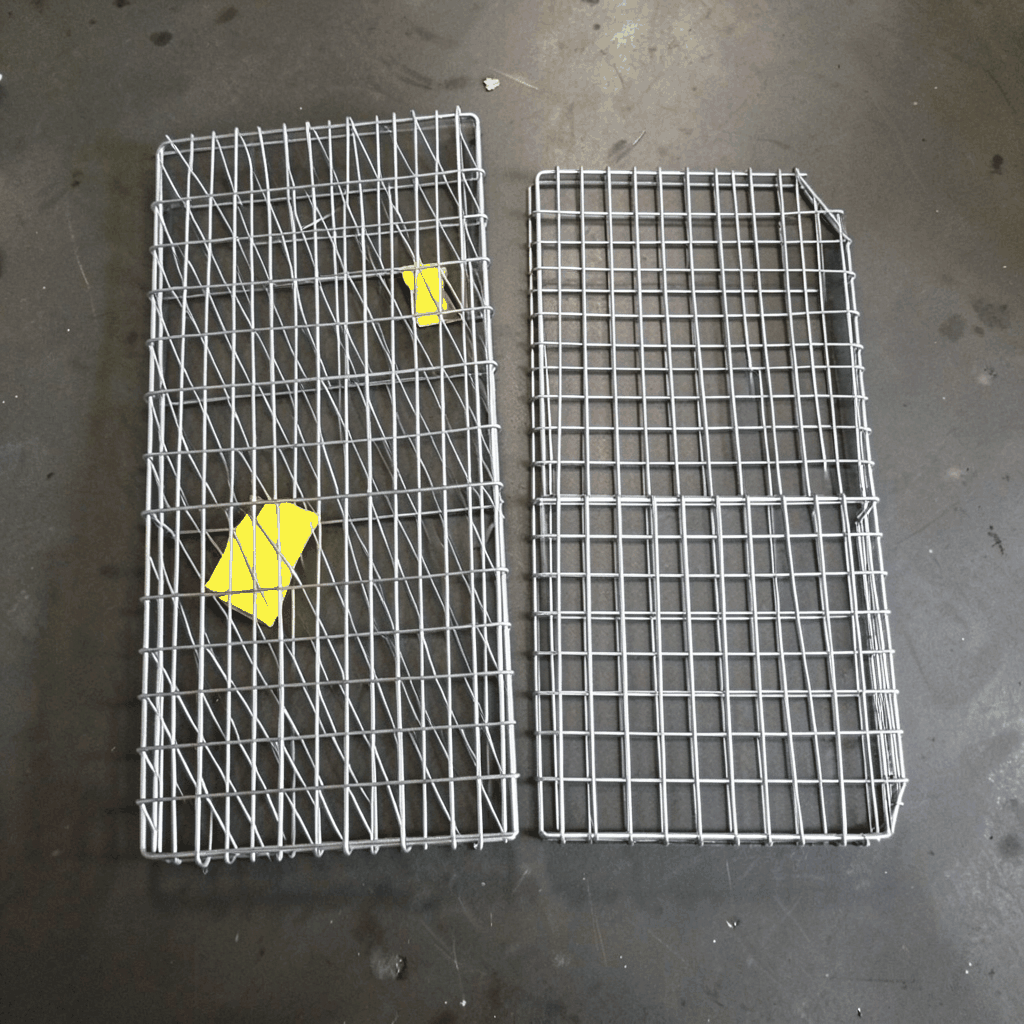
Size is only one part of a commercial barbecue mesh specification. A kitchen may need reinforced edges, welded frames, lifting handles, feet, hooks, dividers, or removable sections. These features can make the product easier to load, turn, stack, clean, and store. A frame can add rigidity to a large grate, while a reinforced perimeter can reduce distortion during repeated heating cycles.
For production kitchens, divided mesh trays can separate different ingredients or cooking stages. This helps prevent cross-contact between products and makes batch handling faster. A basket-style design can hold small pieces during roasting or smoking, reducing the need for foil and limiting product loss through large grill openings.
Surface treatment should be selected with the application in mind. A plain stainless steel finish may be appropriate for many food preparation settings, while a specialized finish could be considered where release, corrosion resistance, or appearance is especially important. Any coating or treatment used near food should be evaluated for temperature resistance, durability, and hygiene requirements.
Practical specifications worth discussing
Before placing an order, kitchen operators and equipment integrators should provide accurate information about the intended use. Useful details include internal appliance measurements, maximum working temperature, food dimensions, loading weight, washing method, storage conditions, and the frequency of use.
- Measure the actual support points, cooking area, and available clearance rather than relying on a product name or nominal grill size.
- Select wire diameter and opening size according to food weight, ingredient dimensions, airflow needs, and expected thermal cycling.
- Specify reinforced edges, handles, dividers, or feet when the mesh will be moved frequently or loaded with heavy products.
- Confirm the metal grade, welding quality, finish, and cleaning compatibility before approving a production sample.
- Request a trial piece when the mesh will be used with a new appliance, automated line, or unusual cooking process.
Clear specifications help the manufacturer balance strength, heat transfer, handling comfort, and cost. They also reduce the risk of receiving a mesh component that fits physically but performs poorly during actual service.
Comparing standard and custom mesh solutions
Standard barbecue grates may be practical for common appliance sizes and low-volume use. They are often readily available and can suit a kitchen that needs a quick replacement. Their limitations become more apparent when the cooking surface has unusual dimensions, when production volume is high, or when food must be handled in a specific way.
A custom product may require more planning and an initial sample review, yet its service value can be higher over time. The right dimensions can increase usable cooking area, reduce food falling through gaps, and minimize movement during loading. Reinforcement and suitable materials can also reduce deformation and replacement frequency.
| Consideration | Standard barbecue mesh | Custom-sized barbecue mesh |
|---|---|---|
| Equipment fit | Designed around common dimensions | Made for measured appliance supports and clearances |
| Cooking area | May leave unused gaps or create overhang | Uses the available surface more efficiently |
| Food support | General-purpose opening pattern | Opening size selected for specific ingredients |
| Handling | Basic form and limited accessories | Handles, frames, dividers, feet, or baskets can be added |
| Durability | Varies by stock material and construction | Material and wire diameter matched to operating conditions |
| Replacement | Convenient when a matching size is available | Repeat orders can follow an approved production specification |
| Initial process | Usually quick to purchase | Requires measurement, drawing, sampling, and confirmation |
The best choice depends on the kitchen’s priorities. For a small operation using a common grill, a standard part may be adequate. For a high-volume kitchen, custom sizing can support smoother workflow and lower disruption, particularly when downtime or inconsistent cooking creates significant costs.
Hygiene, cleaning, and service life
A commercial barbecue mesh must be easy to inspect and clean. Food residue trapped in rough welds, damaged surfaces, or tightly closed joints can create sanitation problems and shorten the useful life of the component. Open, accessible construction allows staff to remove grease and particles more thoroughly after each cooking cycle.
Cleaning procedures should be considered during design. A mesh that is too large or heavy for the washing area may be difficult to handle safely. A removable basket or sectional grate can be more practical than a single oversized piece. Handles should provide enough clearance for gloves and should not create hidden areas where grease accumulates.
Thermal cycling is another important service factor. Repeated heating and cooling can cause inferior mesh to warp, loosen, or develop cracks at stressed welds. Appropriate wire diameter, edge reinforcement, and fabrication quality help maintain the original shape. Routine inspection should check for broken wires, sharp edges, loose welds, and permanent deformation.
A durable component can reduce interruptions caused by frequent replacement. It also supports better housekeeping because employees are more likely to clean and store a mesh product properly when it is stable, manageable, and designed for the actual kitchen environment.
Supporting safer and more efficient operations
Custom barbecue mesh can improve safety by reducing unstable loads and awkward adjustments. A grate that sits securely on its supports is easier to place and remove, while suitable handles keep hands farther from hot surfaces. Dividers and baskets can also reduce the need to manipulate small ingredients directly over a flame or heating element.
The design should account for the people who use it every day. Excessive weight, sharp edges, poor balance, and difficult storage can turn a technically strong mesh into an inconvenient tool. A practical specification considers glove use, lifting posture, cleaning access, rack storage, and the space available around the appliance.
Custom parts can also integrate with a broader kitchen system. Mesh trays may be sized for existing racks, carts, ovens, smokehouses, or washing equipment. When dimensions are coordinated across several stations, employees spend less time transferring food between incompatible containers and can maintain a more orderly production flow.
For a manufacturer and processor such as Shuo Ke Wire Mesh Product Technology Co., Ltd., this type of project involves more than cutting wire to a requested length. It requires interpreting measurements, selecting suitable metal, deciding on a fabrication method, and producing a component that performs under real commercial conditions.
Building a dependable custom mesh specification
The ordering process should begin with drawings, photographs, or precise measurements of the appliance. Include the length, width, depth, corner shape, support location, clearances, and any areas that must remain open for burners, heating elements, or grease drainage. If the mesh will rotate or slide, explain the movement and loading direction.
Next, describe the product being cooked and the working routine. A grate for large meat portions will have different structural requirements from a fine basket for diced vegetables. Information about maximum load, temperature range, cleaning chemicals, and outdoor exposure allows the manufacturer to recommend an appropriate combination of material, opening, wire, and edge construction.
A sample or prototype is valuable before full production. It can reveal interference with supports, awkward handling, insufficient rigidity, or cleaning difficulties that may not be visible in a drawing. Once approved, the sample becomes a useful reference for repeat orders and future modifications.
When the design, material, and dimensions are aligned, custom barbecue mesh becomes a reliable part of the cooking system rather than a disposable accessory. It can improve production consistency, protect food from loss, and help commercial kitchens use their equipment more effectively.
Discuss your appliance measurements and operating requirements with Shuo Ke Wire Mesh Product Technology Co., Ltd. to develop a barbecue mesh solution suited to your cooking line. A well-defined custom component can deliver the fit, durability, hygiene, and handling performance that busy commercial kitchens require.